✨ While we await the election results of the BMC, it feels intriguing to journey back in time and revisit the story of what we now call MUMBAI…
🏛 Bombay Presidency: Colonial Foundations
- The Bombay Presidency was one of the major administrative divisions of British India.
- It began in 1661, when the Portuguese ceded the seven islands of Bombay to England as part of Catherine of Braganza’s dowry. By 1668, the East India Company leased them and developed Bombay into a port city.
- Over the 18th and 19th centuries, the Presidency expanded to include MAHARASHTRA, GUJARAT, KARNATAKA, and SIND, making it vast and diverse.
- "Aden" though geographically outside the Indian subcontinent, was attached to the Bombay Presidency for ease of administration. As a strategic port on the Arabian Peninsula, "Aden" served primarily as a naval and commercial outpost, ensuring British control over maritime routes in the Arabian Sea and the Red Sea.
- Bombay became the capital, with POONA [PUNE] serving as the summer capital.
- ECONOMICALLY, the Presidency thrived on cotton exports, shipping, and trade, turning Bombay into India’s financial hub.
- POLITICALLY, it was a hotbed of reform and nationalism, with leaders like BAL GANGADHAR TILAK and PHEROJSHAH MEHTA shaping early movements.
- TILAK famously popularized the GANAPATI FESTIVAL [A HINDU GOD & AN IDEOLOGY] as a public celebration, rallying people under the devotional cry “GANAPATI BAPPA MOARYA”. By transforming a private household ritual into a collective civic festival, he created a socially and politically safe yet powerful platform for community solidarity and call to action.
THE IDEOLOGY
A Précis [SYNOPSIS] <<< TARGET, >>> SEEKING THE MUZZLE [GUN POINT]
Aiming to change and transform the MARATHI IDENTITY, build a nationalist discourse, and build a resistance against colonial restrictions on political gatherings. TILAK's genius lay in turning a seemingly casual everyday devotion into a TROJAN HORSE of socializing and politics. It would be an insult to TILAK's genius if I did not reveal the power of his DUAL STRATAGEM. Not only did it spur action within his community, but it also helped preserve the CASTE SYSTEM while keeping the community united.
The HINDU CASTE SYSTEM [JAT! DELIBERATE PUN ON THE WORD] in INDIA has no real biological or scientific basis; it is a social construct—evolved from the fortuitous and fortunate or otherwise, play of human genetics in shaping physical personality. Over the ages, the caste system has persisted and been strengthened, particularly by enforcing marriages within the same caste, among other attributes that determine caste identity. Unfortunately and in due fairness it was a "total disaster", because the very play of human genetics that had a role in emergence of CASTE SYSTEM led to inconsistencies within the caste, causing emotional agony within the community. TILAK sought to ease the tensions within his community and to channelize this power of psychological disturbance outward and away from his community. Hence the REVIVAL & IDEOLOGY [CONCEPT PERSONIFIED]
TILAK succeeded in building strong solidarity within his community, in popularizing a call to action that resonated deeply with his people, and equally important, in creating a platform for resistance against restrictions on political gathering. However, his reach in shaping a broader nationalist discourse, especially the NORTH, was very limited. Moreover, the dual call to action though succeeded in keeping the caste system intact, it failed to change and transform the MARATHI IDENTITY as envisioned. Instead it sculpted, regardless of caste membership in the HINDU CASTE SYSTEM that is no different from any other in the country, a UNIQUE COLLECTIVE PERSONALITY of MARATHI people that sticks and stands out.
As with any journey or exploration, one encounters unveilings, hints, and whispers of truths more profound and deeply intriguing.
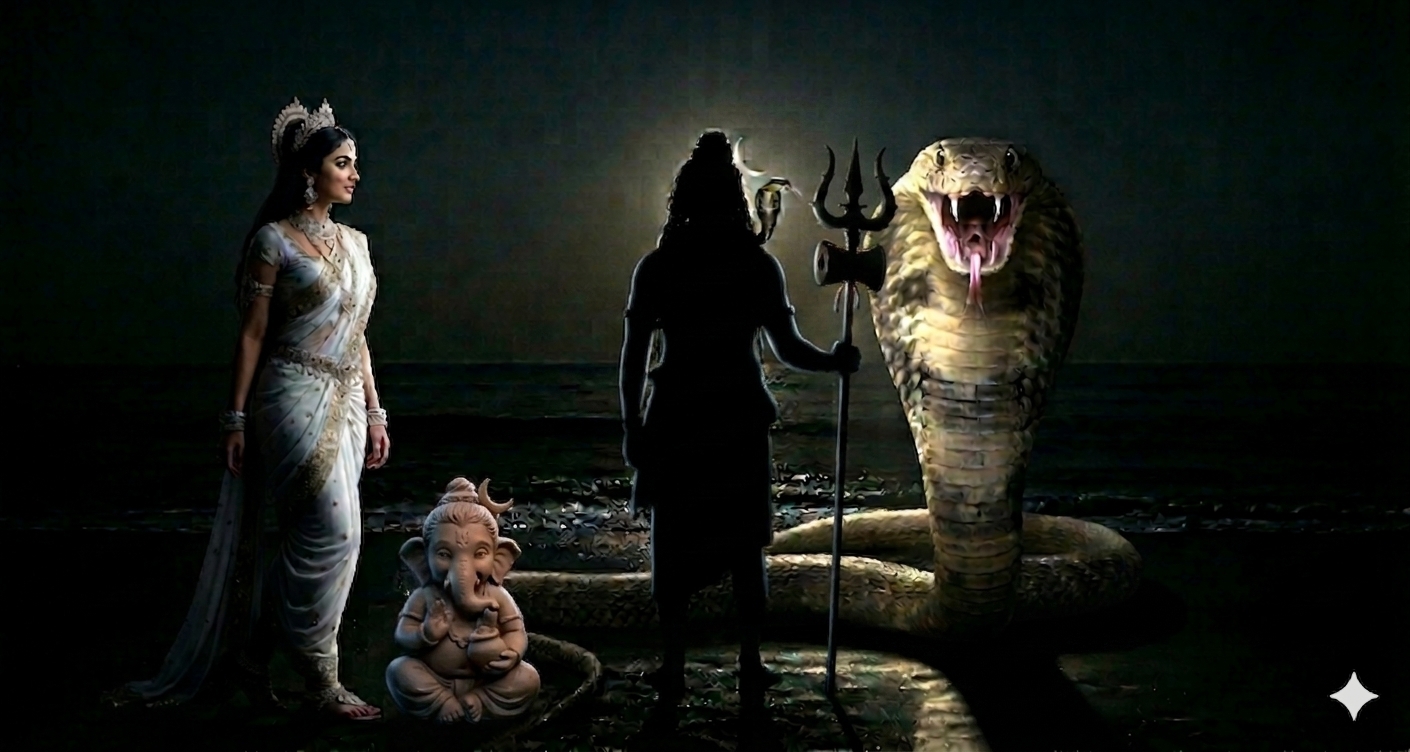
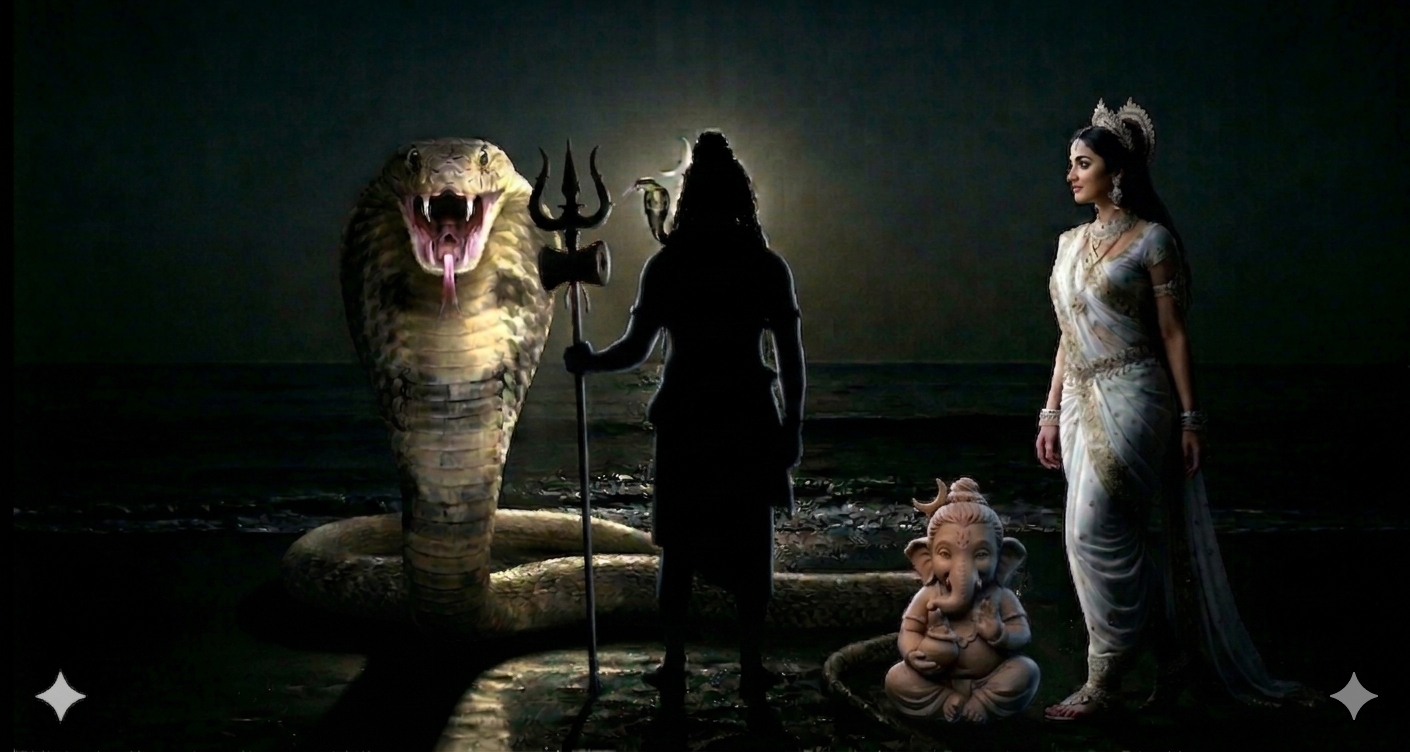
It should be borne in mind while continuing the narrative of GANAPATI as both deity and ideology that the omission, of LORD SHIVA and HIS connection to the ideology, would be a grave sin. Though this lends the narrative a mythological touch, the truth of the matter is that from the point of view of intellectual rationale and in accordance with Aryan Philosophy — Lord Shiva represents a Dual Philosophical Concept of God Himself [CONTRAST THIS WITH THE HINDU SANATAN DHARMA PHILOSOPHY?]. He in His Role as Lord Shiva in the Holy Trinity only has the power to Destroy and Regenerate the WHOLE UNIVERSE.
This duality stands in contrast to the embodiment of purity in Lord Ram and Lord Krishna — in flesh and blood and in thought and action — perfect human images and embodiment of all the Divine Attributes An Ideal King should have of Lord Vishnu — a philosophical concept of God Himself in His Role as The Preserver of WHOLE UNIVERSE, which was and can only be created by Lord Brahma — a philosophical concept of God Himself in His Role as The Creator. They shine radiant as kings of kings, set against embodiment of something that is sinister, destructive, and shadowed by evil — though creation itself, seemingly by chance, fallen out of divine favor.
In the realm of Providence nothing is by chance. Together with God Himself — the human race and all His creations — the Covenant/s — and the existential evil, they all form the basis for any theological thought or philosophy expressed in different ways.
This brief introduction to Aryan Philosophical Viewpoint is essential to help you understand the adaptations and the deviations and the modifications underlying the ideology. In this regard, an introduction to concept of Goddess Laxmi representing — beauty — wealth — prosperity as a Consort to Lord Vishnu — is in order. You will learn later how this fits into the ideology. The wisdom underlying the concepts presented so far is that A King should strive for A Consort an embodiment in attributes of Goddess Laxmi for ensuring his successor — wealth and prosperity for the welfare of his subjects. Strive to imbibe within himself all attributes of Lord Ram as A Warrior King in providing A Military Might to defend his Dominion. Strive to imbibe within himself all attributes of Lord Krishna as A Master STRATEGIST and TACTICIAN.
Any theological thought or philosophy is not abstract; it expresses itself in the ideology, culture, and behaviour of the people who follow or practice the philosophy.
This narrative of GANAPATI as both deity and ideology would be incomplete without getting you acquainted with his CONSORT GAURI AND HINDU GOD VITHALA OR VITHOBA as worshipped by MARATHI people. There is no consensus, GUARI is variously referred to as a wife, a sister and even a mother of DIETY GANAPATI, varying from region to region in MAHRASHTRA. Regardless, GAURI is welcomed and worshiped in same ritualistic manner offered to Goddess Laxmi in other parts of the country where the Goddess is idolized and worshipped. Whereas, the HINDU GOD VITHALA OR VITHOBA is a philosophical adaptation of Lord Krishna, idolized and personalized in form and personalized in philosophy, that deeply identifies with the MARATHI people.
By now, the stark parallelism and the semantical connections between names and concepts should have come to your attention. What hasn't come to your attention is a deceptively powerful and resourceful mental structure for remembrance, selective attribution, self-serving dual comparative inversion, and communication. This should give you a very critical and defensive insight into the psychological makeup of the people.
Ah yes, mythological touch, merely a crafty art to portray and to psychologically and physically distance itself from the reality while carving a DUALITY OF PURPOSE & IDENTITY within the confines of the philosophy.
When you discover something truly fascinating, you feel compelled to dig deeper and deeper. It is like reading a whodunit—you just do not want to put it down.
It began by taking you back in time, offering a glimpse into the history of MUMBAI. You will soon learn that MUMBAI’S journey began with the division of the BILINGUAL STATE into MAHARASHTRA and GUJARAT. GUJARATIS form nearly 20% of MUMBAI’S population, and it is fitting to briefly touch upon the ideology of the people of GUJARAT since we have already raised the topic of ideology.
GUJARATIS generally greet each other with 'JAI SHRI KRISHNA' Lord Krishna plays a transformative role. LIKE the MARATHI people, GUJARATIS idolize and transform Lord Krishna in form to identify with their community. HOWEVER, UNLIKE MAHARASHTRIANS, no philosophical personalization occurs. While GANAPATI is revered as a deity, it is interesting to note that Lord Ram, though idolized, remains largely inconspicuous.
Now contrast this with greetings such as 'JAI SHRI RAM' or 'RAM RAM' in the northern towards the eastern regions. Lord Ram and Lord Krishna are conspicuously idolized and transformed to identify with the people of the region, but again, the philosophical essence is largely unaltered.
QUITE interesting, isn’t it? Strikes a chord? A thought exercise for you.
As a concluding thought, hope this has served as an eye‑opener, offering deeper insight into the philosophy underlying the ideologies.This deserved a special mention for it is now deeply embedded in the core of the MARATHI and GUJARATI psyche, cutting across party lines and giving MUMBAI and MAHARASTRA a DISTINCT IDENTITY — a celebration bigger than any in the COUNTRY.
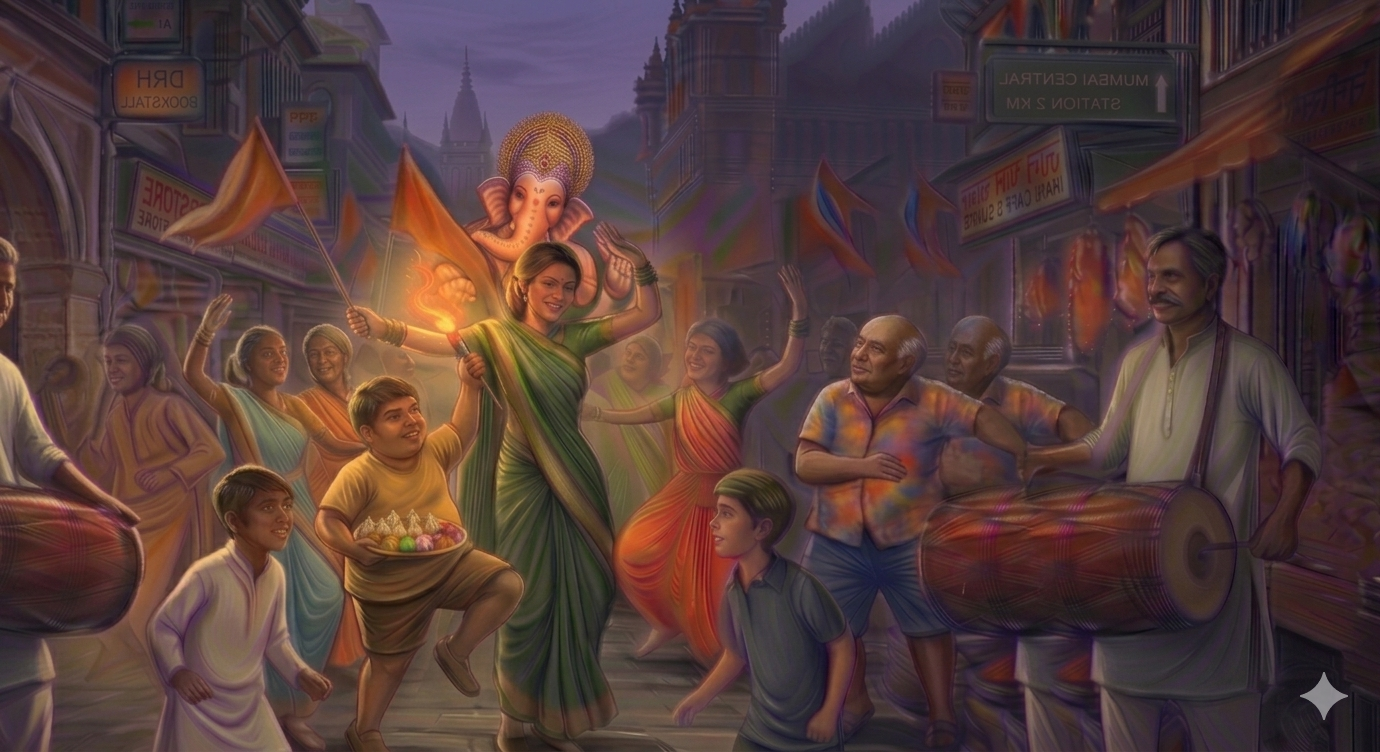 'NACHAAT ALE RE NACHAAT ALE, GANPATI BAAPA NACHAAT ALE!'
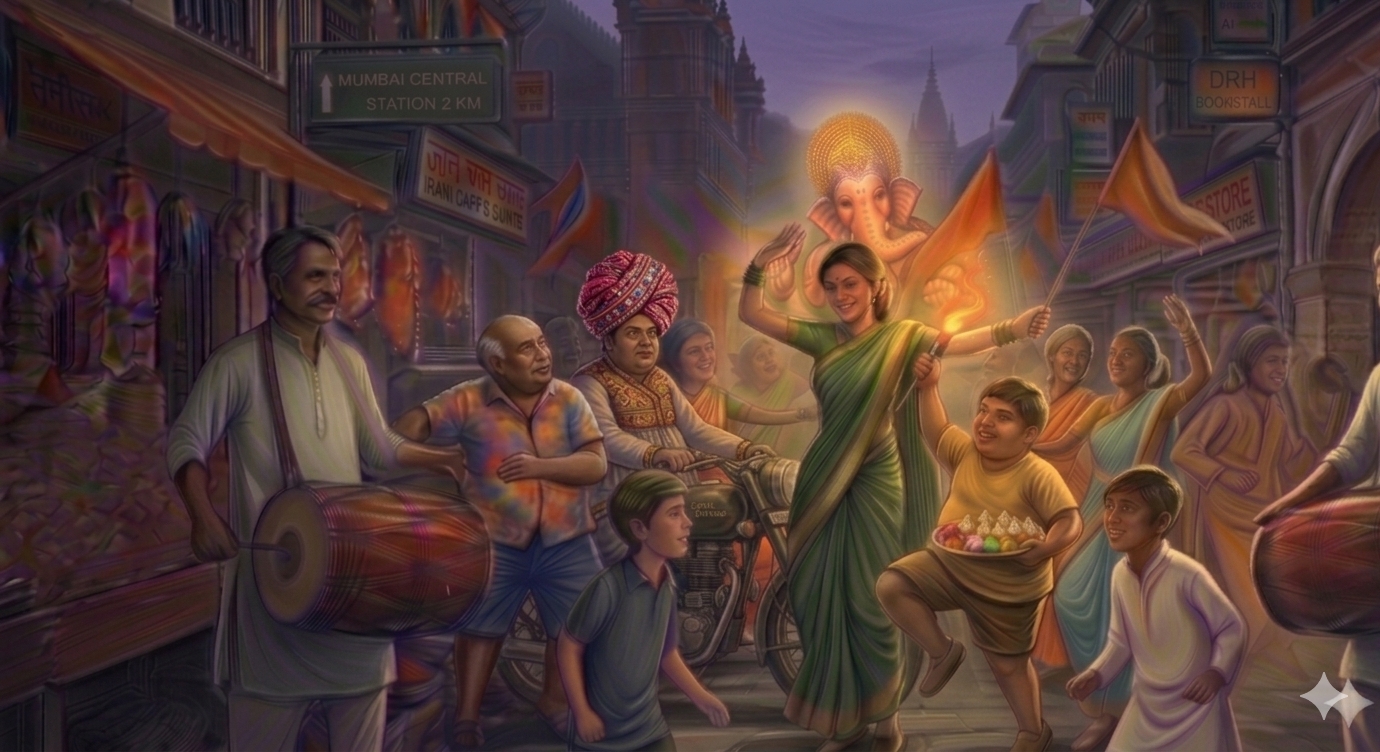
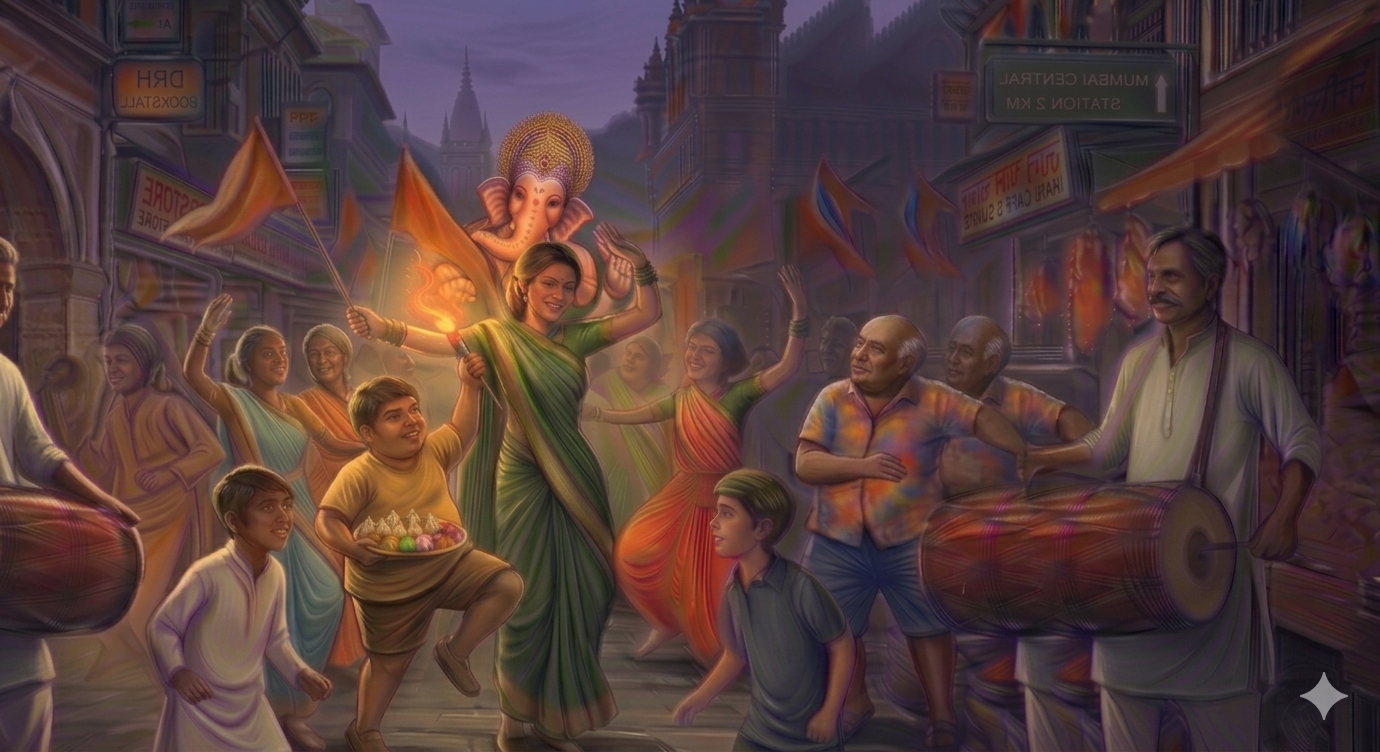 'NACHAAT ALE RE NACHAAT ALE, GANPATI BAAPA NACHAAT ALE!'
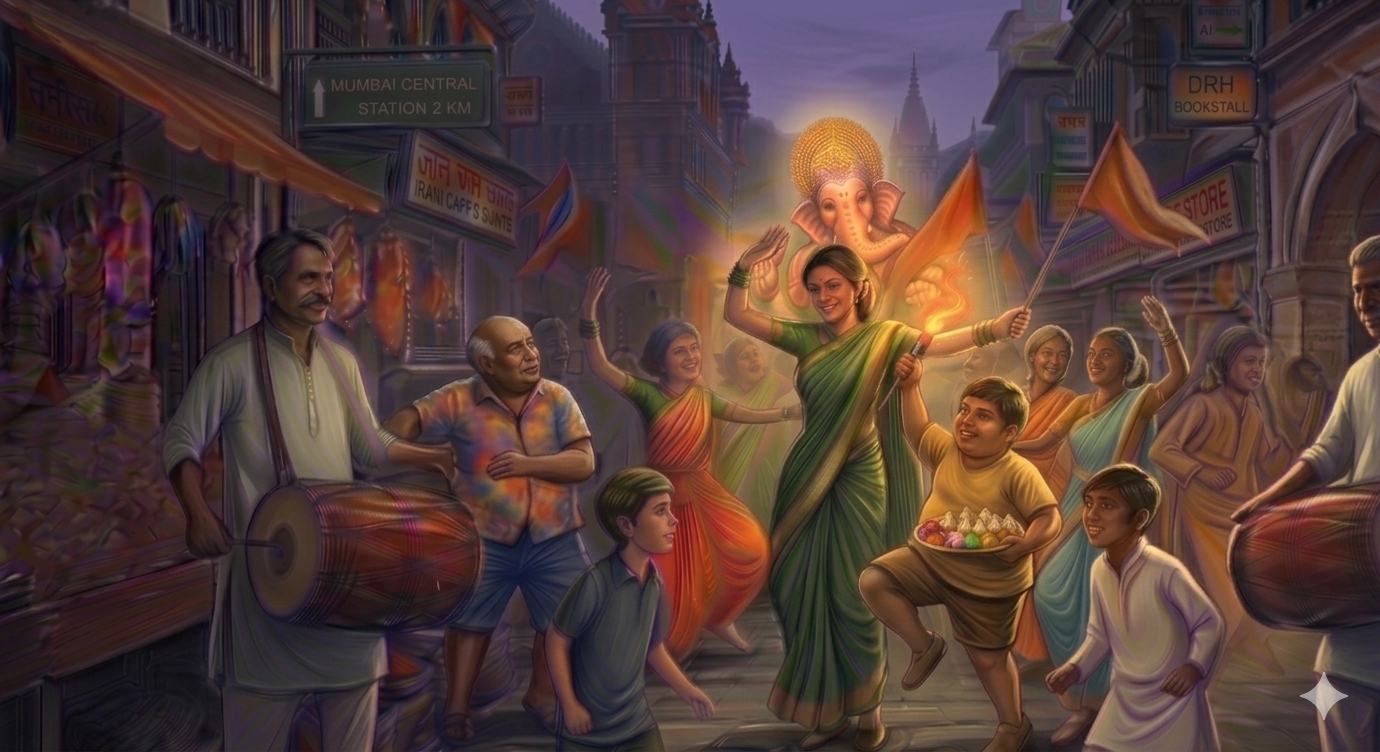
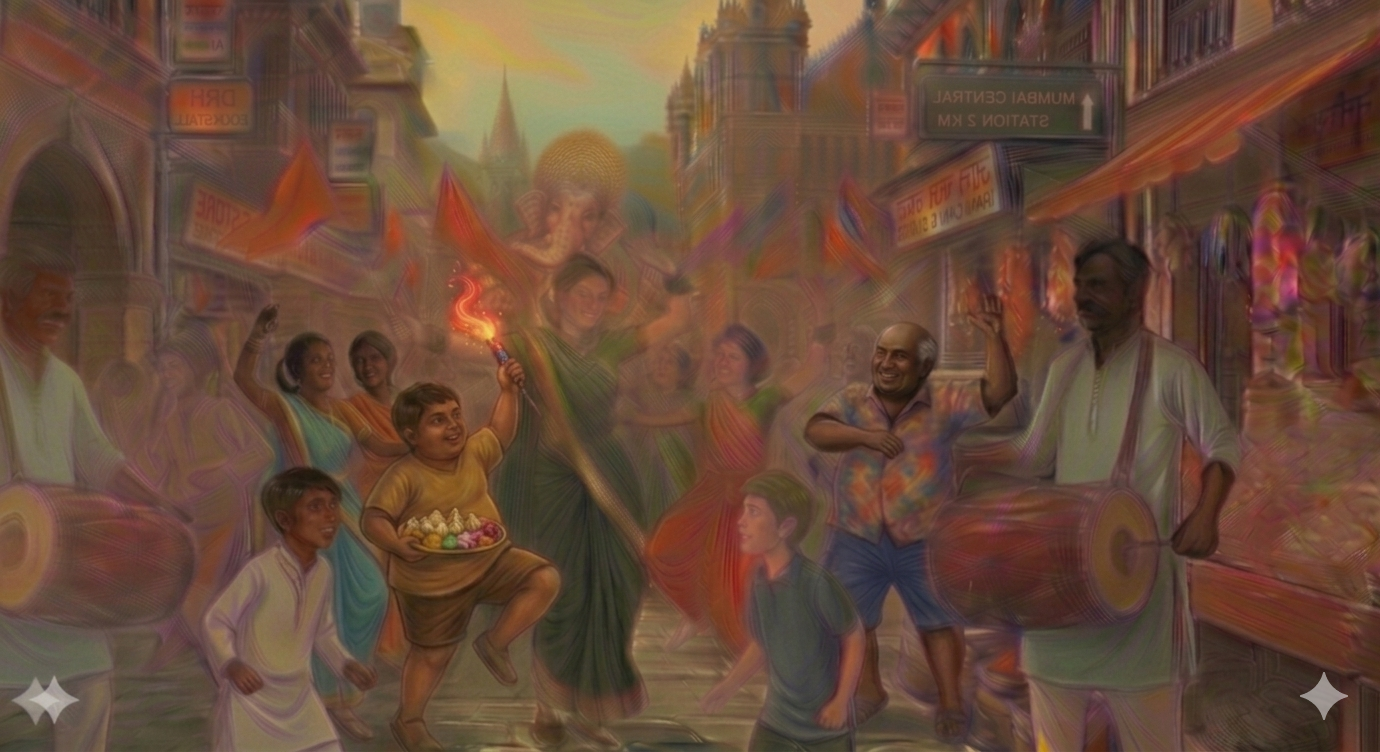 'GANPATI BAPPA MOARYA HYA VARSHI LOVEKAR YA!'
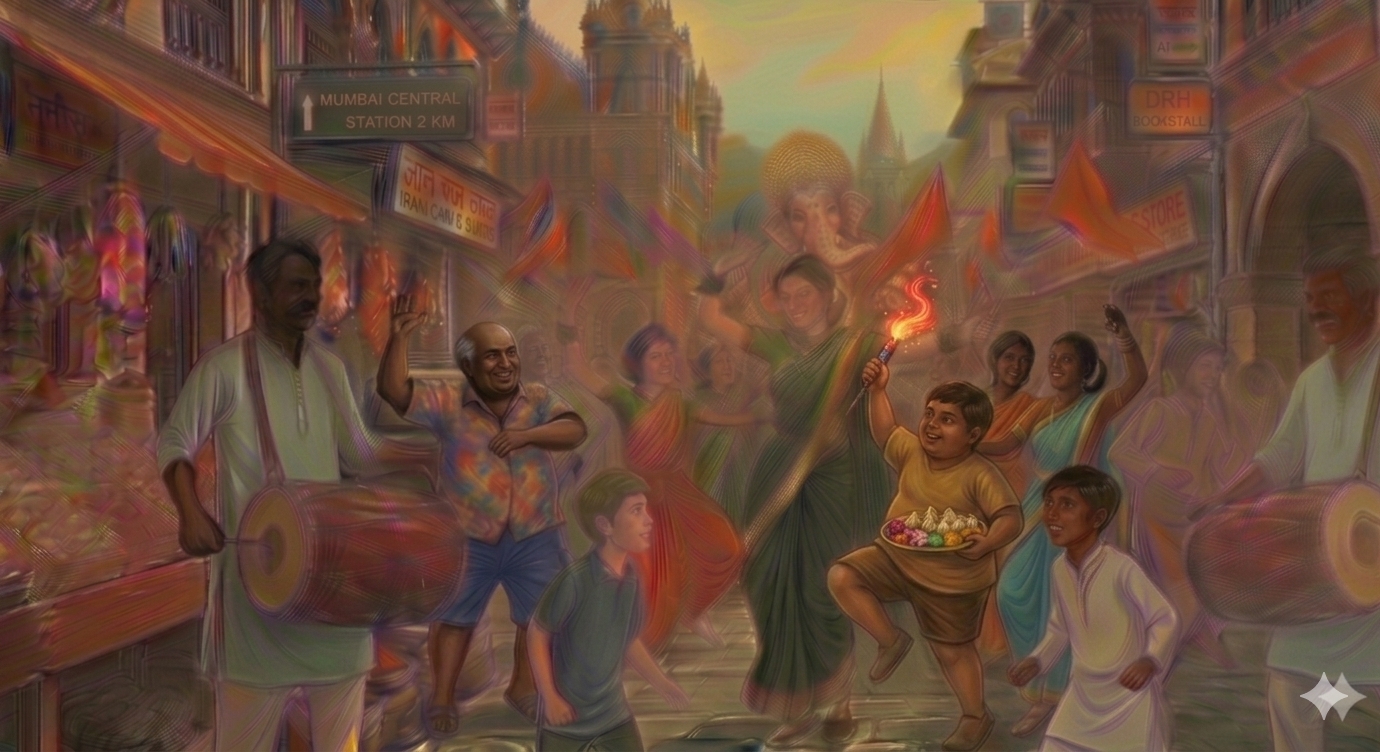
 'GANPATI BAPPA MOARYA'


📜 From Presidency to STATE OF BOMBAY
- In 1937, the Presidency was reorganized into Bombay Province.
- After independence in 1947, it became the STATE OF BOMBAY in 1950.
- This state was bilingual, encompassing both MARATHI-speaking and GUJARATI-speaking regions, along with parts of Vidarbha and Marathwada.
⚔️ Linguistic Reorganization & Division (1960)
- Linguistic tensions grew, with the SAMYUKTA MAHARASHTRA MOVEMENT demanding a MARATHI-majority state and GUJARATI leaders pushing for their own.
- On 1 May 1960, the bilingual STATE OF BOMBAY was divided into MAHARASHTRA and GUJARAT.
- BOMBAY CITY, though contested, was integrated into MAHARASHTRA and became its capital.
- This day is celebrated as MAHARASHTRA DAY and GUJARAT DAY.
💡 Cultural & Family Ties Across Communities
- Despite the earlier tensions between MARATHI and GUJARATI communities, there have always been close cultural and family ties.
- Intermarriages, shared business networks, and overlapping traditions have kept the two groups intertwined.
- This interconnectedness has a strong bearing on the political dynamics of the region and nationwide impact, shaping alliances and seemingly rivalries.
🏙 BOMBAY Becomes MUMBAI
- In 1995, BOMBAY was officially renamed MUMBAI, after MUMBA DEVI, the local goddess.
- Today, MUMBAI stands as the FINANCIAL CAPITAL of INDIA, a city that embodies centuries of transformation—from Portuguese islands to British port, from Presidency to STATE, and finally as the BEATING HEART and CAPITAL of MAHARASHTRA.
🐯 Emergence of BAL THACKERAY'S SHIV SENA and HINDU IDEOLOGY
- BAL THACKERAY, often hailed as "SAMRAT" [EMPEROR], was a cartoonist turned fiery orator who founded the SHIV SENA in 1966.
- The party was named after the MARATHA warrior king CHHATRAPATI SHIVAJI MAHARAJ, invoking strong HINDU PRIDE and regional identity.
- Initially, SHIV SENA’s agenda centered on protecting the rights of the 'sons of the soil' — MARATHI-speaking HINDUS — against perceived domination by migrants in MUMBAI. He rallied his people regardless of caste under a powerful force of call "AMCHI MUMBAI AMCHI MANSA". Another stroke of genius and since then, has become an integral part of the core psyche
- Through aggressive street politics, rallies, and cultural symbolism, the party became a powerful force in MUMBAI’s civic and political life.
- By the late 1980s and 1990s, SHIV SENA expanded its influence by aligning with broader HINDUTVA IDEOLOGY, positioning itself as a defender of HINDU interests across MAHARASHTRA.
- Under Thackeray’s leadership, the party gained control of the BRIHANMUMBAI MUNICIPAL CORPORATION [BMC] and later formed a government in MAHARASHTRA in alliance with the BJP in 1995.
- BAL THACKERAY’s persona — blending HINDU symbolism, MARATHI pride, and populist rhetoric — left a lasting imprint on MUMBAI’s political landscape.
🏛 BRIHANMUMBAI MUNICIPAL CORPORATION [BMC]
- 🏛 The BRIHANMUMBAI MUNICIPAL CORPORATION [BMC]—also known as the Municipal Corporation of Greater Mumbai—is the governing civic body of MUMBAI, India. Established in 1888 under the BOMBAY MUNICIPAL CORPORATION ACT, it is the largest and richest municipal corporation in India, managing an annual budget larger than that of several Indian states.
- 🏛 History: Founded in 1888, with roots in earlier civic governance reforms led by SIR PHEROZESHAH MEHTA. Its headquarters, an iconic Gothic-style building, was completed in 1893.
- 👥 Structure: The corporation has 227 seats and is led by a Municipal Commissioner. The Mayor and Deputy Mayor positions are presently vacant.
- 🌆 Responsibilities: BMC oversees civic infrastructure, public health, sanitation, education, water supply, roads, and disaster management—essentially the day-to-day functioning of MUMBAI.
- ₹💰 Significance: With its vast resources, BMC plays a crucial role in shaping MUMBAI’s urban development and maintaining services for over 20 million residents.
🌆 MUMBAI DEMOGRAPHICS 2026
- MUMBAI, India’s financial capital, is a megacity of ~22–27 million people.
- Population Overview: City Population (2025): ~18.2 million; Metro Area Population: ~26.9 million. Literacy Rate: ~89.7%. Sex Ratio: ~853 females per 1000 males.
- Demographic Composition by Gender: Male: ~52–53%; Female: ~47–48%. The sex ratio remains skewed with fewer women per 1000 men.
- Demographic Composition by Religion: Hinduism: ~65%; Islam: ~20%; Christianity: ~8%; Others (Buddhism, Jainism, Sikhism, Parsis, Jews): ~7%.
- Demographic Composition by Ethnicity: Marathi (native Maharashtrian): ~35–40%; Gujarati: ~20%; North Indian (UP, Bihar migrants): ~15–20%; South Indian (Tamil, Telugu, Malayali, Kannadiga): ~10%; Parsis (Zoroastrians): <1%; Sindhi, Punjabi, Anglo-Indian, others: ~5–7%; Minority diasporas (Jewish, Armenian, etc.): <1%.
📈 GDP of MUMBAI and MUMBAI METROPOLITAN REGION [MMR]
MAHARASHTRA’s economy is one of the largest in India, with MUMBAI CITY and the wider MUMBAI METROPOLITAN REGION [MMR] contributing the majority share. The rest of MAHARASHTRA, though geographically vast, plays a vital role through agriculture, manufacturing, and industrial hubs.
| Region | GDP [2025] | Share of MAHARASHTRA’s GSDP | Key Drivers |
|---|---|---|---|
| MUMBAI CITY [excluding MMR] | ~₹12–13 lakh crore [~US$168B] | ~28–30% | Finance, trade, entertainment, shipping, IT services |
| MMR [excluding MUMBAI] | ~₹15–16 lakh crore [~US$216B] | ~33–35% | Ports, manufacturing, real estate, services |
| Rest of MAHARASHTRA [excluding MUMBAI & MMR] | ~₹16 lakh crore [~US$216B] | ~35% | Agriculture [Vidarbha, Marathwada], industry [Pune, Nashik, Aurangabad], textiles, chemicals, infrastructure |
KEY POINTS
- Total GSDP [2025–26]: ~₹43–45 lakh crore [~US$600B]
- MUMBAI CITY + MMR together contribute ~63–65% of the state’s GDP
- Rest of MAHARASHTRA contributes ~33–35%, driven by agriculture, manufacturing, and logistics
- PUNE, NASHIK, AURANGABAD, and NAGPUR are major hubs sustaining industrial and agricultural output
₹💰🗳 BRIHANMUMBAI MUNICIPAL CORPORATION [BMC] FINANCIALS & POLITICAL SIGNIFICANCE
₹💰 FINANCIALSAnnual Budget (2025–26): ₹74,427 crore — the largest civic outlay in India, marking a 14.19% rise from the previous year. Revenue Income (Estimated): ₹43,159 crore, with a projected surplus of ~₹60.65 crore.
Expenditure: Capital expenditure ~₹43,162 crore (~58%), salaries for ~1.5 lakh employees, and civic services including health, sanitation, education, and welfare schemes. Scale: With resources exceeding those of many Indian states, the BMC is a financial powerhouse shaping Mumbai’s urban development and sustaining services for over 20 million residents. 🗳 POLITICAL SIGNIFICANCE
|
Truly, it is time for a break...
NOT BEFORE, some thoughts for U on Community And Communication. Look at the 2 Words. Right away U see the connection.
THOUGHTS ON COMMUNICATION:
“Communication leads to community, that is, to understanding, intimacy and mutual valuing.” — Rollo May
'Communication leads to Community of understanding and intimacy and mutual valuing.' — Slightly Modified For Styling.
THOUGHTS ON BLUNT COMMUNICATION:
'Blunt Truth and Open Communication are the lifeblood of a Healthy Community.' — Modern Leadership Maxim
"Community without Blunt Honesty in Communication is only a fragile illusion.” — Adapted Principle
THOUGHTS ON LANGUAGE:
'A Language is UR Medium Of Communication and A Virtual Private Network Connection and A Defense. BUT BEWARE — it can be breached!'
CLOSING THOUGHTS:
Extend courtesy even to UR enemy — unless UR dealing with a devil...
Don't let UR Community become defenseless.
Courteous Wit versus Blunt Rudeness — therein lies the difference between External Modes for Community Engagement and Communication and Survival.
Keep away from the stupid and the jealous. They both do harm. One inadvertently and the other intentionally.
What is more important is the Blunt Truth and An Open Communication in the Internal Mode of Community Engagement.
What do U do with the less-aware and the pseudo-intellects within the Community. There is not much U can do with the pseudo-intellects. They keep rocking the boat and U have to keep it afloat. Be patient with the less-aware. Let them see the big picture and drive sense into them gradually. We all do stupid things at times — We learn.
'BUT NEVER FORGET THE DEVIL PRAYS N PREYS.'